Why London’s Glass Gets Cleaned by Rope: A Buyer’s Guide to Window Cleaning at Height
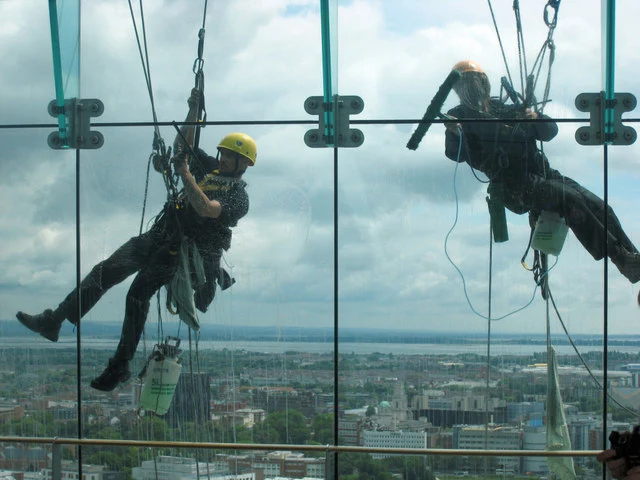
Look up almost anywhere in central London on a dry weekday and you’ll eventually spot one: a figure suspended halfway down a glass façade, working methodically across a pane, apparently untroubled by the two hundred feet of air beneath their boots.
Most passers-by find it alarming. Facilities managers find it reassuring — because that figure usually represents the safest, fastest and cheapest way to clean the building they are standing under.
Here’s why, and what to look for when you’re the one signing the contract.
Start with the law, not the ladder
Every conversation about cleaning at height in the UK begins with the Work at Height Regulations 2005, which set out a hierarchy any competent contractor should be able to recite: avoid working at height where it is reasonably practicable to do so; where you can’t avoid it, use equipment or other measures to prevent a fall; and where a risk of falling remains, use equipment that minimises the distance and consequences of a fall.
Ladders aren’t banned — that’s a persistent myth — but they sit awkwardly against that hierarchy. They prevent very little, they minimise nothing, and they are unstable on the uneven pavements, basement lightwells and street furniture that surround most London commercial buildings. For anything above the second or third floor, ladder-based cleaning is effectively indefensible.
That leaves four realistic methods, and the right one depends far more on the building than on the contractor’s preference.
Water-fed poles: the ground-level default
A telescopic carbon-fibre pole feeding purified, deionised water to a brush head lets an operative clean from the pavement. Because the water carries no dissolved minerals, it dries without spotting and needs neither detergent nor a squeegee finish.
It is the safest option available, because it removes work at height entirely — the top of the hierarchy. It’s also quick, quiet and cheap. The limitation is reach: practical working height is usually somewhere around four to six storeys, less if there’s an obstruction. Deep window reveals, projecting balconies, heavy setbacks, atria and internal courtyards all defeat it. So does heavy soiling — pole work is excellent maintenance cleaning and mediocre restoration cleaning.
Cradles and BMUs: brilliant when the building has one
Many purpose-built towers include a permanently installed building maintenance unit — a roof-mounted davit or track system carrying a suspended cradle. Where one exists and is properly maintained, it’s an efficient way to work.
The caveats are real. Suspended access equipment is lifting equipment, which brings it under LOLER and means thorough examination at statutory intervals by a competent person. Cradles are slow to reposition, sensitive to wind, and expensive to hire in if the building does not already have one. A great deal of London stock — particularly converted and heritage buildings — has no cradle at all, and plenty of installed units are out of service precisely when you need them.
MEWPs: right building, wrong street
Cherry pickers and boom lifts are excellent on out-of-town business parks with generous hardstanding. In central London they run into the city itself: nowhere to set outriggers, restricted street access, red routes, pedestrian flow, and sometimes the need for a licence or a temporary closure. They are also height-limited compared with the buildings that most need cleaning.
Rope access: the London answer
Which brings us back to the figure on the rope.
Rope access — properly, industrial rope access; colloquially abseiling — puts a trained technician on two independent ropes: a working line they descend on, and a back-up line attached to a fall-arrest device. Every anchor, connector and device is inspected before use. The technician works with both hands free, moves vertically at will, and can reach recesses, atria, lightwells, ornate façades and setbacks that no cradle or boom will ever touch.
The industry standard is IRATA, whose three-tier certification structure requires logged working hours and periodic reassessment, and whose safety record across many millions of working hours is one of the reasons insurers and building managers take it seriously. A compliant team never works solo — there is always a Level 3 supervisor on site capable of performing a rescue.
The operational advantages are usually what sell it. Rope teams mobilise in minutes rather than hours, need no road space, no scaffold and no vehicle at the kerb, and can work outside occupied hours without shutting anything down. On a mid-rise office block, abseiling window cleaning will often complete the same façade in a fraction of the time a cradle would take, at a fraction of the cost of hiring in access equipment, and with no disruption to tenants or to the street below.
What to ask before you appoint anyone
The market has a wide quality spread, and price alone tells you almost nothing. Whichever access method a contractor proposes, ask for:
- A site-specific RAMS. A risk assessment and method statement written for your building — not a generic template with your address pasted at the top. It should name the access method, the anchor arrangements, the ground-level exclusion zones and the rescue plan.
- Certification you can verify. IRATA levels for rope teams, with certificate numbers. Confirm that a Level 3 supervisor will be on site.
- Anchor point documentation. Eyebolts and anchor devices need periodic inspection and testing by a competent person, typically annually. If your building has never had this done, that’s a job to schedule before the cleaning rather than after — and a contractor who doesn’t raise it is telling you something.
- Insurance with meaningful limits. Public liability appropriate to a city-centre building, plus employers’ liability. Ask for the certificate, check the expiry date, and check the limit rather than the mere fact that a policy exists.
- A clear approach to the ground. Exclusion zones, signage, banksmen where pedestrian traffic warrants it, and coordination with your own security team.
Established providers of commercial window cleaning London buildings depend on will supply all of that unprompted — and will tell you honestly when a cheaper method would do the job perfectly well: poles for the lower floors, ropes for everything above.
Frequency is a maintenance decision, not a cosmetic one
It’s easy to treat window cleaning as housekeeping. It isn’t, quite.
Airborne pollutants, salt and the alkaline run-off from concrete and masonry sit on glass and etch it over time. Left long enough, that staining becomes permanent and requires restoration or replacement — dramatically more expensive than cleaning. Sealed-unit gaskets and frame finishes degrade faster under accumulated grime. And on buildings with photovoltaic glazing or solar shading, soiling carries a measurable performance cost.
There is also the human side that facilities managers understand better than accountants: daylight is one of the most reliable predictors of occupant satisfaction in commercial space, and dirty glass measurably reduces it. Tenants notice. Prospective tenants notice more.
For most London commercial buildings, quarterly external cleaning is a sensible baseline, monthly for prestige frontages and ground-floor retail, and twice-yearly as an absolute minimum for anything else. Set it as a scheduled contract rather than a reactive one, because reactive cleaning is always more expensive and always looks worse in between.
The short version
Choose the access method that fits the building, insist on documentation, verify the certification, and schedule the work rather than remembering it.
And the next time you walk under someone hanging off a London office block — they’re almost certainly on two ropes, supervised, insured, and doing the job in the safest way available to them.
Publishing notes (delete before submission)
Word count: ~1,250
Anchor 1: commercial window cleaning London → https://www.efficientcleaning.co.uk/
Anchor 2: abseiling window cleaning → https://www.efficientcleaning.co.uk/abseiling-window-cleaning/
Suggested title tag: Window Cleaning at Height: A Buyer’s Guide for London Buildings
Suggested meta description: Water-fed poles, cradles, MEWPs or rope access? How to choose a safe, compliant window cleaning method for a London commercial building — and what to ask contractors.
Suggested image alt text: Rope access technician abseiling down the glass facade of a London office tower