How to Choose Bedroom Furniture That Still Works in Ten Years
Most bedroom furniture gets bought twice. Once in a hurry — a frame that fits the budget, a chest that fits the gap by the window — and again three or four years later, when the drawers stick, the joints creak and nothing quite matches anything else. The second round almost always costs more than getting it right the first time would have.
The difference usually isn’t budget. It’s sequence. A few measurements taken before anything goes into a basket, and a clear idea of which piece the room is built around, will give you a bedroom that still works in ten years — at more or less any price point.
Start with the room, not the range
Before looking at a single product, draw the room. Rough is fine, but note four things: the internal dimensions wall to wall, the position and swing of the door, the height and depth of the window sill, and where the radiator and sockets sit.
Those four constraints decide more than taste does. A radiator under the window rules out a chest in the warmest, most obvious spot. A door that opens inwards eats roughly a metre of usable corner. A low sill limits headboard height on that wall.
Then mark out clearances. You want around 60–70cm to walk down each side of a bed that two people use, and enough space in front of a chest of drawers or wardrobe to open it fully and still stand there — usually 75–90cm depending on drawer depth. Rooms fail on clearance far more often than on square footage. A 3m x 3m bedroom laid out well feels calmer than a 4m x 3.5m one where every drawer fouls the bed.
The bed sets everything else
The bed frame is the anchor decision. Its size, height and style set the scale for every other piece, so choose it before you choose anything to stand beside it.
Size first, and be honest. A king (150cm) needs roughly 3m of wall-to-wall width to leave sensible access on both sides. A double (135cm) in a smaller room usually beats a king that turns the space into a corridor. If two adults share, the sleep quality gained from that extra 15cm is real — but not if it costs you the ability to open a wardrobe.
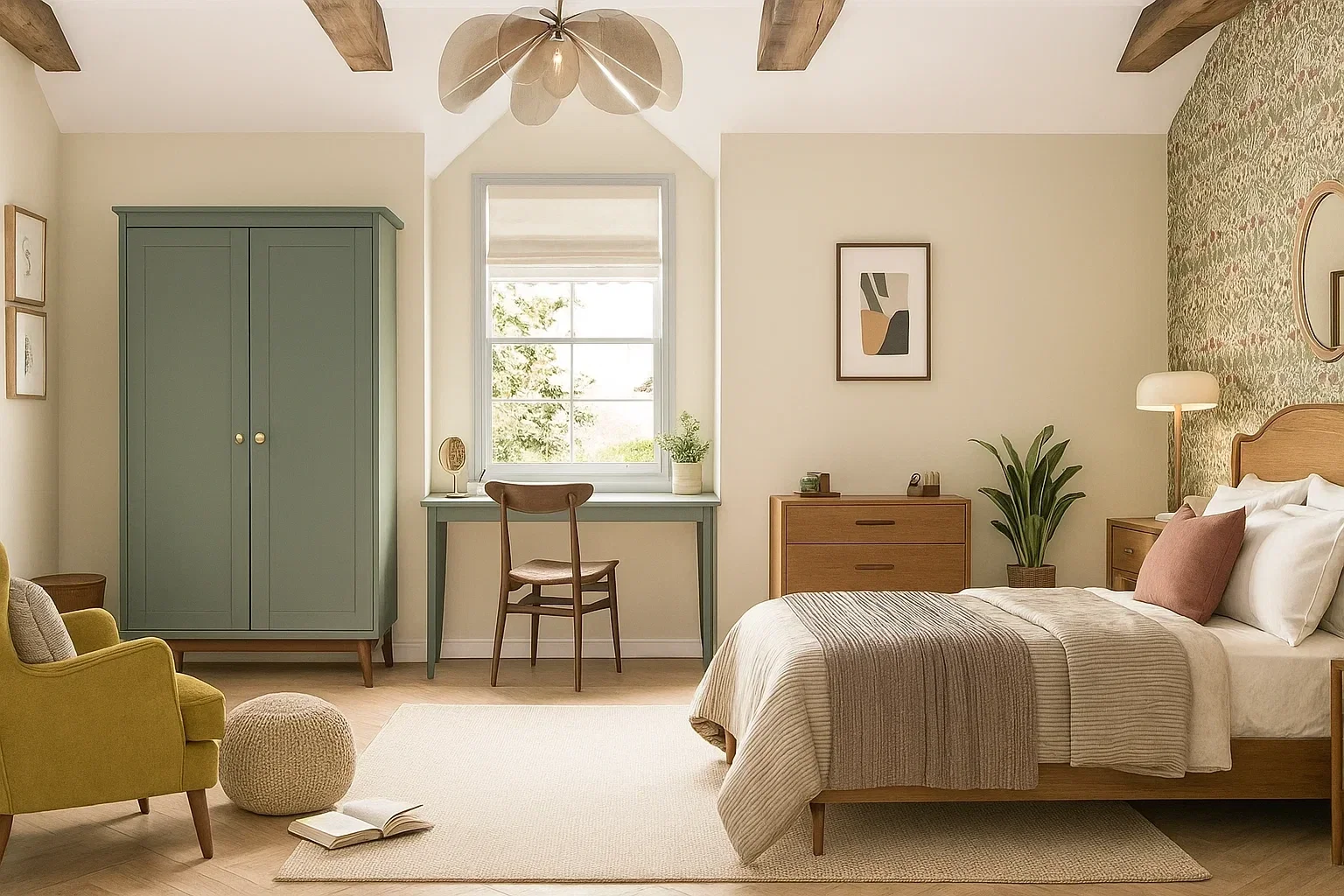
Then height. Bed height changes how a room reads more than most people expect. A low platform frame makes ceilings feel taller and suits smaller rooms; a higher divan or sprung base is easier to get in and out of and gives you under-bed storage. Whatever you choose, your bedside table surface should land within a few centimetres of the top of your mattress. That single relationship does more for how finished a room feels than matching wood tones ever will.
Headboard style matters last, but check the fixing before you order: some bolt to the frame, some to the divan base, and some need wall clearance behind them.
What “solid wood” actually means
Furniture descriptions are written by marketing departments, and the word “wood” covers four very different things.
Solid hardwood — oak, ash, beech, walnut — is cut from the tree. It’s heavy, can be sanded and refinished, holds screws well, and moves slightly with humidity. It costs the most and lasts the longest.
Solid wood with veneered panels is the standard construction for good mid-range furniture: solid frames and legs, with a thin layer of real wood over an engineered core for large flat surfaces such as wardrobe doors. This isn’t a compromise. Engineered panels are more dimensionally stable than wide solid boards, which cup and split. Plenty of very good furniture is built exactly this way.
Foil or laminate over MDF or chipboard is a printed finish, not wood. It can look perfectly fine and is often the sensible choice for a spare room or a child’s room, but it can’t be repaired once chipped, and it doesn’t hold fixings well through repeated assembly.
The tells are physical, so use them in a showroom. Pull a drawer right out. Dovetailed or dowelled joints and a solid back panel mean the maker expected the piece to last; stapled corners and a thin hardboard back tacked on mean they didn’t. Check whether drawers run on wooden runners, metal runners or soft-close mechanisms, and open them fully — a drawer that tips when extended will irritate you every day for a decade.
Storage is where most rooms go wrong
Work out what you actually need to store before deciding what to buy. Count hanging items, then folded items, then the awkward category: bedding, suitcases, shoes.
Hanging space is the usual shortfall. A single wardrobe rail carries far less than people assume. Long hanging — dresses, coats — needs about 150cm of height; short hanging for shirts and folded trousers needs about 100cm, which means a double-hang section can nearly double capacity in the same footprint.
For folded items, chests of drawers are more space-efficient per square metre than open shelving, and deep drawers are less useful than they look. Anything below the top layer gets forgotten. Two shallow drawers usually beat one deep one.
Then decide between fitted and freestanding. Fitted wardrobes use awkward corners and chimney breasts far better and can run floor to ceiling. Freestanding costs less, moves house with you, and doesn’t commit you to a single layout. In a rented flat, or a house you might leave inside five years, freestanding is usually the better financial call.
Matched sets, or a room built slowly
Matching sets are the easy route, and there’s nothing wrong with them. A bed, two bedsides and a chest in one finish will always look coherent.
But rooms assembled gradually tend to look better, as long as you give yourself one rule to hold it together. The reliable one: keep the wood tones in the same temperature family — all warm (oak, cherry, walnut) or all cool (ash, grey-stained, painted) — and let shape and material vary freely. A painted chest, an oak bed and a rattan bedside will sit together happily. The same three pieces in three clashing wood tones won’t.
It helps to shop in that order too. When you start browsing Bedroom Furniture, work outwards from the frame to the storage to the small pieces, rather than buying whatever happens to be reduced and hoping it resolves itself later.
The part everyone forgets
Measure the route, not just the room.
Every year, people take delivery of a wardrobe that fits the bedroom perfectly and won’t go up the stairs. Before ordering anything large, measure the front door width, the narrowest point of the hall, the stair width, the turn on the half-landing, and the bedroom door itself. Then check the product’s boxed dimensions, not its assembled ones.
Ask two questions before you order. Does the price include delivery to the room of your choice? And does it include assembly and packaging removal? Kerbside delivery of a 60kg wardrobe carcass is a very different proposition from a two-person team who will build it upstairs and take the cardboard away.
Also ask what happens if it doesn’t fit. A retailer who will collect and refund a piece that can’t get up your stairs is worth paying slightly more for.
The checklist
- Room drawn, with door swing, window sill, radiator and sockets marked
- 60–70cm walking clearance each side of the bed; 75–90cm in front of drawers and wardrobes
- Bed size chosen for the room, not for the showroom
- Bedside surface height matched to the top of the mattress
- Drawers pulled out and inspected in person, or construction confirmed in writing
- Hanging and folded storage counted, not estimated
- Delivery route measured — front door, hall, stairs, landing, bedroom door
- Delivery, assembly and returns terms confirmed before ordering
None of this takes long. An hour with a tape measure and a pencil, before you spend anything, is the highest-return thing you can do — and it’s the step that separates a bedroom you keep for a decade from one you replace in three years.